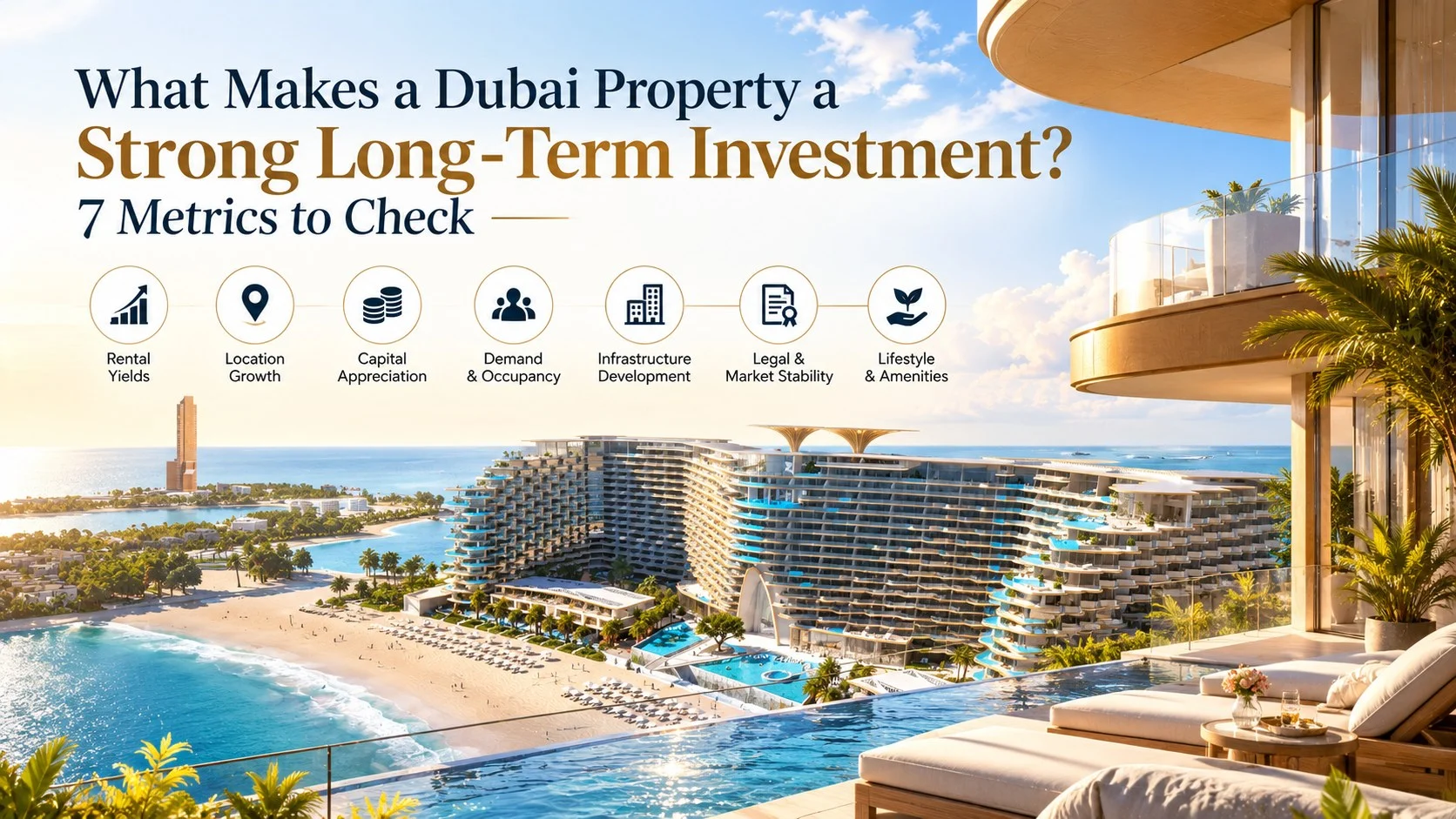


Dubai’s property market has delivered some of the strongest returns in global real estate over the past three years but not every Dubai property is a strong long-term investment. The difference between a property that compounds wealth over 5-10 years and one that merely treads water comes down to a specific set of fundamentals that sophisticated investors evaluate before they buy. In a 2026 market where volume is strong (AED 90.62 billion in Q3 transactions alone), prices have consolidated from the March peak, and selectivity now matters more than momentum, knowing how to evaluate a property is as important as knowing which property to evaluate. Here are the seven metrics every serious buyer should check before committing to a long-term Dubai property investment.
Metric 1: Rental Yield (Gross and Net)
Rental yield is the first number every long-term investor should calculate and most buyers get it wrong by stopping at the gross figure.
Gross yield is annual rental income divided by purchase price. Dubai’s citywide average sits at approximately 6.58% in 2026, with mid-market communities (JVC, Business Bay, Dubai South) typically clearing 7%+ on apartments, and prime villas trading lower at 4.5 – 5% in exchange for stronger capital appreciation.
Net yield after service charges, management fees, insurance, vacancy allowance, and transaction amortisation typically runs 1.5–2.5 percentage points below gross. A 7% gross yield apartment often delivers 4.5–5.5% net.
The honest investor model works off net yield, not gross. If the numbers only work on gross, they don’t actually work.
Metric 2: Capital Appreciation (Historical and Forecast)
Yield is only half the return equation. Capital appreciation shapes the other half and for long-term holds, often dominates total return.
By September 2026, Dubai’s property scene finally calmed down. Prices were rising by about 4.6% year-on-year—nothing like the crazy double-digit spikes everyone saw in 2024 and 2025, but still steady. Analysts actually see this as a good thing—it points to steady, lasting growth instead of a boom-and-bust cycle. ValuStrat forecasts around 10% citywide residential capital value growth for 2026, with villas expected to outperform at approximately 17.7%.
For evaluating any specific property, check: three-year historical appreciation in that specific community, forward forecasts from independent analysts (ValuStrat, Knight Frank, Cavendish Maxwell), and the community’s position in Dubai’s longer price cycle. Entry near a cyclical peak rewards patience; entry at a community’s early maturation point can deliver outsized long-term returns.
Metric 3: Developer Track Record
In a maturing market, developer selection is the single strongest predictor of outcome more than community, more than specification, often more than timing.
Verify three things on every purchase. RERA registration confirming the developer is licensed in Dubai. Escrow account arrangements ensuring payment protection on off-plan purchases. Delivery history showing the developer has handed over previous projects on schedule and to specification. A beautiful render from an unproven developer carries materially higher risk than a modest unit from a developer with ten delivered projects behind it.
In 2026 specifically, premium branded stock from reputable developers is projected to deliver 15–25% five-year appreciation, while generic luxury from unproven names runs closer to 8–15% a bifurcation that reflects buyer sophistication as much as construction quality.
Metric 4: Location Fundamentals and Infrastructure
Location fundamentals are what hold a Dubai property’s value through market cycles. The checklist includes:
- Current infrastructure: road access, metro proximity, airport connectivity
- Planned infrastructure: anything under construction that will shift the community’s accessibility by handover
- School and amenity density: families drive long-term rental demand, and families follow schools
- Employment proximity: communities close to office clusters support stronger rental retention
- Current transaction volume: Q3 2026 data showed Dubai South leading with 5,165 transactions and JVC second with 2,312 (up from 1,992 in Q2) volume signals genuine demand
A property with weak location fundamentals can look attractive at launch but struggles through market cycles. A property with strong fundamentals compounds in value whatever the market does short-term.
Metric 5: Supply-Demand Dynamics in the Specific Community
Citywide market data is useful; community-specific supply-demand is decisive.
Check three signals. Current absorption rate determines how quickly new units are selling and being tenanted. Pipeline supply how many new units are scheduled for handover in the next 3-5 years, and whether that pipeline is likely to pressure rents or prices. Tenant pool depth determines whether the community attracts a broad enough tenant base (families, young professionals, corporate tenants) to sustain demand through economic cycles.
Communities where supply is finite and demand is structural (scarcity-led prime districts like Palm Jumeirah, Emirates Hills) behave very differently from communities with large pipelines (which can face rental and price pressure at handover waves). Both can be strong investments but the right strategy differs.
Metric 6: Service Charges and Operating Cost Efficiency
Service charges are the quiet killer of Dubai property ROI. They’re often disclosed late in the sales process and sometimes rise materially after handover.
Request the historical service charge for the specific building (last three years if ready stock, projected if off-plan), compare it against comparable buildings in the same community, and verify what the charges actually cover. Standard Dubai apartment service charges run approximately AED 12–20 per sq ft per year, with luxury and branded developments reaching AED 25–40 per sq ft or higher.
A premium amenity package with high service charges can still make sense if the amenities genuinely drive rental demand. A premium charge for underused amenities simply erodes net yield.
Metric 7: Resale Liquidity and Transaction Velocity
The final metric is often overlooked by first-time investors but matters enormously over long-term holds: how easily can you sell this property when you want to exit?
Resale liquidity depends on three things. Community transaction velocity: how many comparable units sell per quarter. Buyer pool breadtwhether the community attracts both end-users and investors (narrow buyer pools create exit risk). When people talk about resale pricing, they’re really asking whether homeowners can sell their units at or above what they originally paid. If homes in a community consistently hold or grow in value over time, that’s a strong sign. In contrast, weak resale activity is a red flag and should make any investor think twice about long-term exit options.
In 2026, nearly half of all residential deals in Dubai about 47% came from the resale market, and just in Q3, that added up to AED 30.83 billion. That’s a lot of money changing hands, and it proves people really want secondhand homes, especially in the neighborhoods that are already well established.
Where do Aark Terraces come in? Let’s break it down:
Aark Terraces is a mid-rise building from AARK Developers. This spot hits the heart of Dubai’s mass-market segment, the same segment that drove a massive 84.28% of all Q3 2026 transactions.
Yields here are solid: apartments in Dubailand typically return between 6.5% and 7.5%. The area’s appreciation prospects look good too, thanks to infrastructure improvements set to run through 2028. AARK Developers themselves are registered with RERA and have a reliable delivery record.
Location-wise, Aark Terraces is in the DLRC master community, near Emirates Road and Al Ain Road, and just 20 minutes from Downtown. Demand keeps up with supply here Dubailand posted strong sales in Q3 2026, and Aark Terraces saw healthy absorption. Service charges are also lower than what you’d pay in prime neighborhoods, keeping operating costs in check. Plus, when it comes time to sell, the mass-market segment is the easiest to trade in; liquidity here is as good as it gets in Dubai.
Entry prices at Aark Terraces start at AED 950,000 for a one-bedroom. Two-bedrooms come in between 1,113 and 1,577 square feet, with a few units even featuring private pools or Jacuzzis. The payment plan is straightforward: 10% down, 50% paid during construction, and the remaining 40% due upon handover.
Frequently Asked Questions
- What makes a Dubai property a smart long-term investment?
Strong long-term Dubai property investments share seven characteristics: healthy net rental yield, proven capital appreciation history, reputable developer with RERA registration, solid location fundamentals, favourable community-level supply-demand dynamics, reasonable service charges, and active resale liquidity. All seven matter; weakness in any one erodes long-term returns. - What rental yields can I expect from Dubai property in 2026? If you look at the numbers for 2026, gross rental yields across Dubai average about 6.58%. Places like JVC, Business Bay, and Dubai South do even better, often over 7% for apartments. Top-end villas give you lower yields, usually between 4.5% and 5%, but they tend to make up for it with solid capital appreciation. Net yields typically run 1.5-2.5 percentage points below gross.
- How much capital appreciation does Dubai property deliver? By September 2026, property values across Dubai had climbed about 4.6% year over year. ValuStrat predicted about 10% growth for the year, with villas leading the pack at nearly 17.7%. Also, if you buy into premium, branded projects from reputable developers, you’re looking at somewhere between 15% and 25% appreciation over five years.
- How do I check if a Dubai developer is reliable? Start with the basics. Make sure they’re registered with RERA in Dubai. But you want more than numbers. Always make sure developers use proper escrow accounts for off-plan deals that keeps your money safe. Check their history, too. People don’t just chase fast growth anymore; they care about lasting quality.
- Which areas have the strongest long-term investment outlook in Dubai?
Some mid-market communities like Dubai South, JVC, and Dubailand are poised for good growth, thanks to new infrastructure and development. Established, prime communities think Palm Jumeirah, Dubai Hills Estate, Downtown benefit from scarcity and steady demand. If you’re after something up-and-coming, keep an eye on Arjan and Business Bay, especially as emerging commercial hubs. Match the area to your investment horizon and yield-vs-growth priority. - What are typical service charges on Dubai property?Standard Dubai apartment service charges run approximately AED 12-20 per sq ft per year, with luxury and branded developments reaching AED 25-40 per sq ft or higher. Always request historical service charge data for the specific building before purchasing.
The Bottom Line
A strong long-term Dubai property investment is defined by seven converging fundamentals: rental yield (gross and net), capital appreciation potential, developer quality, location fundamentals, community supply-demand dynamics, operating cost efficiency, and resale liquidity. Properties that score well across all seven compound wealth over 5-10 years holds; properties that fail on any one dimension can underperform even in a strong citywide market. For investors approaching Dubai property investment in 2026, this framework separates the properties that genuinely build long-term wealth from those that merely look attractive at launch. Choose the project carefully, run honest numbers against all seven metrics, and Dubai continues to offer one of the strongest risk-adjusted real estate propositions in global markets today.