

Every major property market is built on infrastructure long before it’s built on cranes. Ras Al Khaimah is a textbook example unfolding in real time. Across roads, aviation, maritime access and integrated hospitality mega-projects, the northernmost emirate is being physically rewired for a step-change in how it lives, works, welcomes tourists and attracts capital. The result is a Ras Al Khaimah real estate market that is being fundamentally re-rated not through hype, but through steel, tarmac and terminal capacity. Here’s how the infrastructure story is reshaping RAK property, and what it means for anyone looking at investment opportunities today.
Ras Al Khaimah’s Infrastructure Momentum in 2026
The scale of the ongoing investment is what makes this cycle different. In 2025, Ras Al Khaimah pulled in AED 39 billion in foreign direct investment spread over 17 projects more than any other emirate that year. Fast forward to the first quarter of 2026, and economic licence capital climbed 15.5% from the previous year, hitting AED 11.5 billion. In Q1 2026, economic-licence capital rose 15.5% year-on-year to reach AED 11.5 billion. RAK is investing simultaneously across roads, aviation and maritime a three-front upgrade that directly supports its 2030 economic diversification and competitiveness goals.
For the emirate’s real estate sector, the effect has been immediate.The residential market stayed hot too. Villa prices weren’t far behind, rising about 4%. Rents didn’t sit still either; they climbed 6% for apartments and 5% for villas. Infrastructure is driving demand, and demand is driving property values.
Roads: Cutting the Distance Between RAK and Dubai
The most impactful infrastructure work is happening on RAK’s road corridors. Upgrades to the E11 Sheikh Mohammed bin Salem Road and the E311 Sheikh Mohammed Bin Zayed Road are expected to cut travel time between Ras Al Khaimah and Dubai by up to 45%. That single figure changes almost everything about the RAK proposition.
A 45% shorter Dubai commute meaningfully expands who can realistically live in RAK Dubai professionals, weekend homeowners, cross-emirate business owners, families splitting time between both markets. It also strengthens RAK’s appeal to international buyers who want proximity to Dubai’s infrastructure without paying Dubai prices. For anyone evaluating a real estate investment in Ras Al Khaimah, the road upgrades are the quiet story that reshapes everything else.
Aviation: The RAK Airport Expansion
RAK International Airport crossed one million annual passengers for the first time in 2025 a milestone the emirate isn’t planning to stop at. The airport is now targeting 3 million passengers annually by 2028, supported by a comprehensive expansion package.
The programme includes a new 30,000 sq m passenger terminal1,500 sq m VVIP terminal, an 8,000 sq m multi-purpose hangar, and an additional 9,000 sq m of apron and parking. The new terminal, developed in partnership with Falcon Executive Aviation, is expected to open in Q1 2027. For the RAK real estate market, more direct international connectivity means more tourists, more overseas buyers arriving to view properties, more relocation flows and a stronger case for both hospitality-led development and second-home ownership.
Al Marjan Island: Where Infrastructure Meets Luxury Property
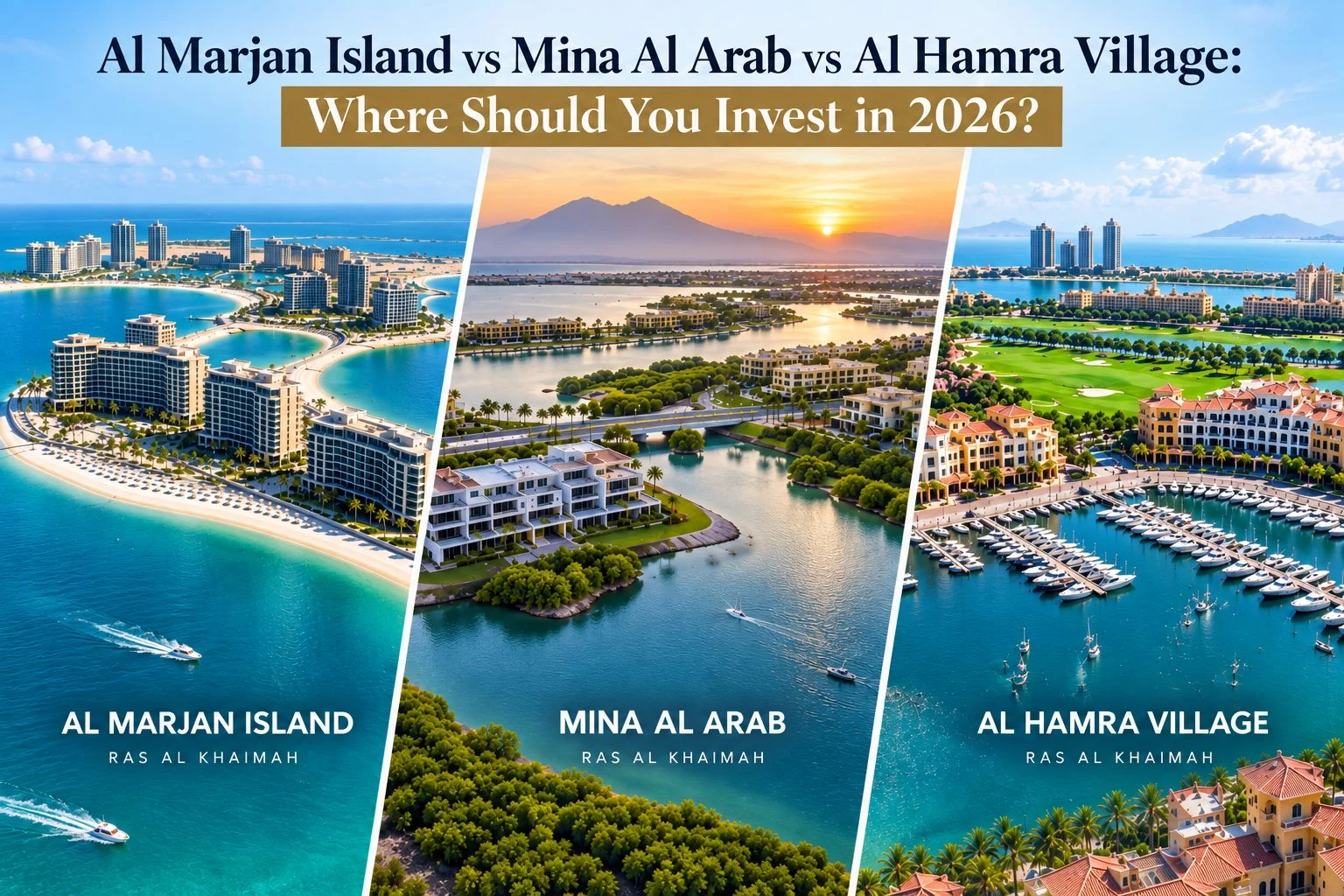
No infrastructure story defines RAK’s future more visibly than Wynn Al Marjan Island, the AED 18.7 billion integrated resort under development on a 60-hectare artificial island. The 70-storey resort tower is already at an advanced stage of construction, and will house the Middle East’s first regional gaming floor alongside hotels, ocean-promenade restaurants, a harbour and private villas. The resort’s opening originally planned for spring 2027 will now be phased in through 2027 following a modest schedule adjustment announced by developers.
The pre-opening effect on Al Marjan Island real estate has already been dramatic. Prime apartment prices rose approximately 21% year-on-year in early 2026 Global luxury developers Karl Lagerfeld, Nikki Beach, Aldar, Ellington, Luxe Developers have committed some of the most ambitious projects the UAE has seen this cycle, making Al Marjan one of the strongest candidates for the best real estate investment in Ras Al Khaimah today.
What This Means for the Ras Al Khaimah Real Estate Market
The infrastructure investments are triggering a sustained supply response. Cavendish Maxwell forecasts 25,600 new residential units delivered between now and 2030, with apartments representing 97% of the pipeline. Delivery activity accelerates sharply from 2027, peaking at 9,100 units in 2029.
That supply is underwritten by real demand. RAK’s population is projected to grow from 450,000 today to 650,000 by 2030, a ~44% increase and off-plan sales already account for 85% of RAK’s residential transactions. When you combine population growth, FDI leadership, tourism expansion, and a maturing developer roster, the market signals all point in the same direction. RAK isn’t emerging any longer. It’s arrived.
Why This Is a Defining Moment for Investors
For investors, the infrastructure moment matters because it is the foundation underneath the appreciation story that follows. Buyers entering the market during the infrastructure build-out before roads open, before the airport terminal launches, before Wynn opens capture the upside as those catalysts activate one by one. Buyers entering after each milestone pay more for the same asset.
Sophisticated investors are treating this as a barbell within the wider UAE property landscape pairing established Dubai assets from a proven real estate development company in Dubai with earlier-cycle RAK exposure. It’s the strategy institutional capital is increasingly running, and it’s working because both markets serve genuinely different portfolio roles.
Frequently Asked Questions
How is Ras Al Khaimah infrastructure changing the real estate market? Major upgrades to roads (E11 and E311), airport expansion, and integrated mega-projects like Wynn Al Marjan Island are driving population growth, tourism, FDI, and property values with 25,600 new homes planned by 2030 and prices rising 4–5% in six months.
How will faster roads between RAK and Dubai affect property values? Upgrades to the E11 and E311 highways are set to cut travel time between RAK and Dubai by almost half, making Ras Al Khaimah way more appealing for people looking to buy or rent. That should keep demand strong for apartments, villas, and new launches.
Is RAK a smart real estate bet in 2026? For investors willing to wait three to five years, absolutely. Population is growing 44% by 2030, RAK attracted AED 39 billion in FDI in 2025, prime Al Marjan Island prices rose ~21% year-on-year, and 25,600 new homes are in the pipeline all before the Wynn opening.
When will Wynn Al Marjan Island open? Wynn Al Marjan Island is planned to open in 2027, following a modest schedule adjustment from the original spring 2027 target. The 70-storey resort tower is already at an advanced stage of construction.
How much is RAK Airport expanding? RAK International Airport is targeting 3 million annual passengers by 2028 (from just over 1 million in 2025), with a new 30,000 sq m passenger terminal, VVIP terminal and hangar expansion. The new terminal is expected to open in Q1 2027.
The Bottom Line
Ras Al Khaimah’s infrastructure story is the story of its property market. Roads, airport, maritime and Wynn Al Marjan Island are not separate initiatives; they are one integrated re-rating of the emirate’s economic and lifestyle position within the UAE. For anyone evaluating the RAK real estate market today, the timing question is straightforward: infrastructure catalysts of this scale don’t reverse. They compound. And investors who position ahead of them are the ones who typically look back on this cycle with satisfaction.