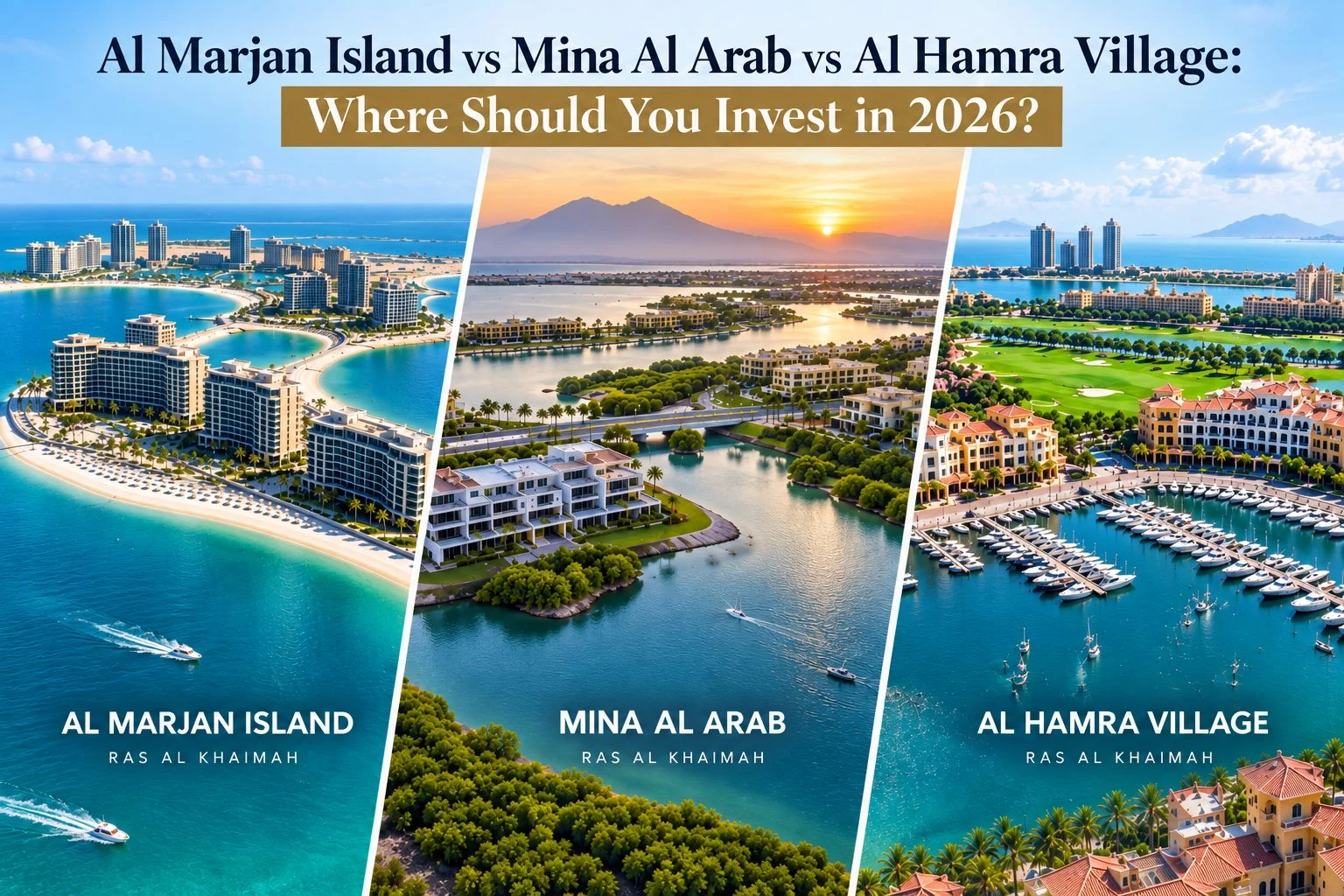


For nearly two decades, “UAE property investment” was essentially shorthand for “Dubai.” Global capital arrived, chose a Dubai postcode, and stayed there. In 2026, that has quietly changed. A growing share of international investors are still buying Dubai but they are pairing it with allocations in other emirates, most notably Ras Al Khaimah, where a maturing luxury market and a rare hospitality catalyst are drawing capital that once flowed exclusively to Dubai Marina, Downtown or Palm Jumeirah. Here is why global investors are diversifying their UAE property portfolios beyond Dubai and how the smartest money is doing it.
Why Dubai Alone Is No Longer the Full UAE Investment Case
There is no anti-Dubai argument in this shift. Real estate investment in Dubai remains one of the strongest, deepest and most liquid property markets in the world, and every serious UAE portfolio still starts there. The change is that Dubai is now a mature market and mature markets behave differently from emerging ones.
Prime Dubai stock is expensive by any global comparison. Yield compression on trophy assets has been meaningful. And while capital appreciation continues, the outsized launch-to-handover gains that defined the last cycle are harder to replicate in the most-transacted districts today. Sophisticated investors know that the highest returns typically come from the market before it reaches full maturity and increasingly, that market sits an hour north of Dubai.
The Rise of Ras Al Khaimah as the UAE’s Second Investment Story
Ras Al Khaimah has quietly emerged as the UAE’s clearest early-cycle luxury market. The transformation has been rapid, and the numbers explain the excitement.
The cost of a nice apartment on Al Marjan Island went up a lot, about 21 percent from the start of 2025 to the start of 2026. Now the price of an apartment that is right on the water is around AED 2,428 for each square foot. Multiple analysts forecast a further 15–20% price rise in prime coastal zones through 2026. Tourism hit a record 1.36 million visitors in 2025, projected toward 5 million as more than 9,500 hotel keys are delivered between 2026 and 2030. And the single most anticipated milestone in UAE hospitality this decade the $5.1 billion Wynn Al Marjan Island resort opens in 2027, bringing the Middle East’s first integrated gaming destination and rewriting the emirate’s luxury credentials.
That is exactly the profile international investors look for a market with structural demand, limited supply, a proven catalyst and a defensible upside. And this is why Ras Al Khaimah real estate investment has become the fastest-growing conversation in UAE property circles today.
The Diversification Logic: Why Both Markets, Not Just One
The most sophisticated UAE portfolios in 2026 pair Dubai and Ras Al Khaimah rather than choosing between them. The logic is simple.
People like to invest in Dubai because it’s a stable place. Dubai has a lot of things for sale so investors can easily buy and sell things. There are also a lot of people who want to buy these things. The price of them is always clear. This makes Dubai a good place, for people who want to invest in Al Marjan Island apartments and other things. Al Marjan Island apartments are still a choice.
Ras Al Khaimah delivers cycle-stage growth. RAK is where earlier-stage pricing meets a clear, dated catalyst. It offers the appreciation potential that mature markets can no longer match.
Together, they balance a portfolio. Global investors from India, the UK, GCC, Russia and increasingly the US are running exactly this barbell a stabilising asset in Dubai for income and resale liquidity, paired with a higher-growth Ras Al Khaimah investment for appreciation ahead of the Wynn opening. Diversifying across two emirates within one country lets investors participate in different stages of the same underlying UAE growth story without concentrating risk in either.
What Kind of Ras Al Khaimah Property Global Investors Are Choosing
The RAK allocation is concentrating in a handful of high-conviction opportunities on Al Marjan Island. Branded residences are leading the charge. Karl Lagerfeld Beach Residences a $1.4 billion partnership between AARK Developers and the Karl Lagerfeld fashion brand is delivering 663 sea-view residences with a 1,000-foot private beach by 2028. Aldar Properties’ Nikki Beach Residences and Rosso Bay Residences bring branded and design-led product from one of the UAE’s largest developers. Ellington Properties’ Playa Del Sol and Cala Del Mar add design-led luxury at more accessible entry points. Luxe Developers’ Oceano offers an earlier Q3 2026 handover.
For investors used to scanning Dubai’s leading names, the depth of the top developers in Ras Al Khaimah roster is a significant shift and one of the strongest signals that the market is entering a new phase.
Yields, Appreciation and the Timing Advantage
A Ras Al Khaimah investment offers three characteristics simultaneously. Yields on completed apartments have run in the 5.5–5.8% range, with the emirate’s villas and waterfront homes reaching 7–8%. Capital appreciation for buyers who entered in 2024–2025 has already been substantial. Timing works in the buyer’s favour: the market is mid-cycle, with the Wynn opening still ahead.
Off-plan buyers with a 3–5 year horizon are particularly well-positioned entering at today’s launch price, holding through the Wynn opening and post-opening re-rating, then exiting into a more mature market. Compared with achievable returns in the most-transacted Dubai districts today, RAK’s combination of yield and appreciation potential is what is pulling global capital north.
How to Approach a Diversified UAE Property Portfolio
For investors thinking about diversifying beyond Dubai, a few principles hold across every profile.
Start with your goal. Yield-focused investors weight the portfolio differently from those prioritising capital growth. Diversification only works when each allocation has a clear job to do.
Verify the developer before the address. In every emirate, the developer’s track record is a stronger predictor of outcome than the location. Verify escrow, RERA/regulator registration, delivery record and service-charge history before committing.
Match the payment plan to your cash flow. Off-plan plans of 20/30/50, 40/60 or 60/40 have very different capital demands during the construction period. Choose the one your cash flow supports.
Stress-test against a flat market. A UAE property investment case that only works in a rising market is not a case. Run the numbers assuming zero appreciation and confirm the deal still holds on yield alone.
Think in cycles, not months. Cross-emirate diversification is a 3–5 year strategy at minimum. Investors buying for a short-term flip are pursuing a different game.
Frequently Asked Questions
Why are global investors diversifying UAE property beyond Dubai? Dubai is now a mature market with compressed yields on prime stock and higher entry prices. Ras Al Khaimah offers earlier-cycle pricing, strong appreciation potential and a clear catalyst in the 2027 Wynn opening making it an ideal complement to a Dubai allocation rather than a replacement.
Is Ras Al Khaimah a good real estate investment in 2026? Yes, for investors with a 3–5 year horizon. Prime prices rose ~21% year-on-year in early 2026, apartment yields run 5.5–5.8%, villas reach 7–8%, and forecasts point to further 15–20% growth in prime coastal zones through 2026 supported by the Wynn opening and structural tourism demand.
How does Ras Al Khaimah real estate investment compare with Dubai? Dubai offers deeper liquidity and a longer track record; Ras Al Khaimah offers earlier-cycle appreciation and a clear dated catalyst. The two markets serve different portfolio roles Dubai for stability, RAK for growth which is why most sophisticated UAE investors now hold both.
Which Ras Al Khaimah projects are attracting international capital? Branded and design-led launches on Al Marjan Island are leading, including Karl Lagerfeld Beach Residences (AARK Developers), Nikki Beach Residences and Rosso Bay Residences (Aldar), Ellington Properties’ Playa Del Sol and Cala Del Mar, and Luxe Developers’ Oceano.
Can foreigners buy property in Ras Al Khaimah? Yes. Al Marjan Island and other designated freehold zones allow international buyers to own outright. Purchases from AED 2 million may qualify the buyer for a UAE Golden Visa.
The Bottom Line
Diversifying a UAE property portfolio beyond Dubai is no longer a niche move it is fast becoming the default approach for globally minded investors. Dubai remains essential, but pairing it with a Ras Al Khaimah allocation now offers a rare combination of yield, appreciation potential and clear timing that mature markets alone can’t deliver. Choose reputable developers, run conservative numbers, and treat cross-emirate diversification as a genuine long-term strategy, and your UAE property investment case gets stronger not through concentration, but through balance.