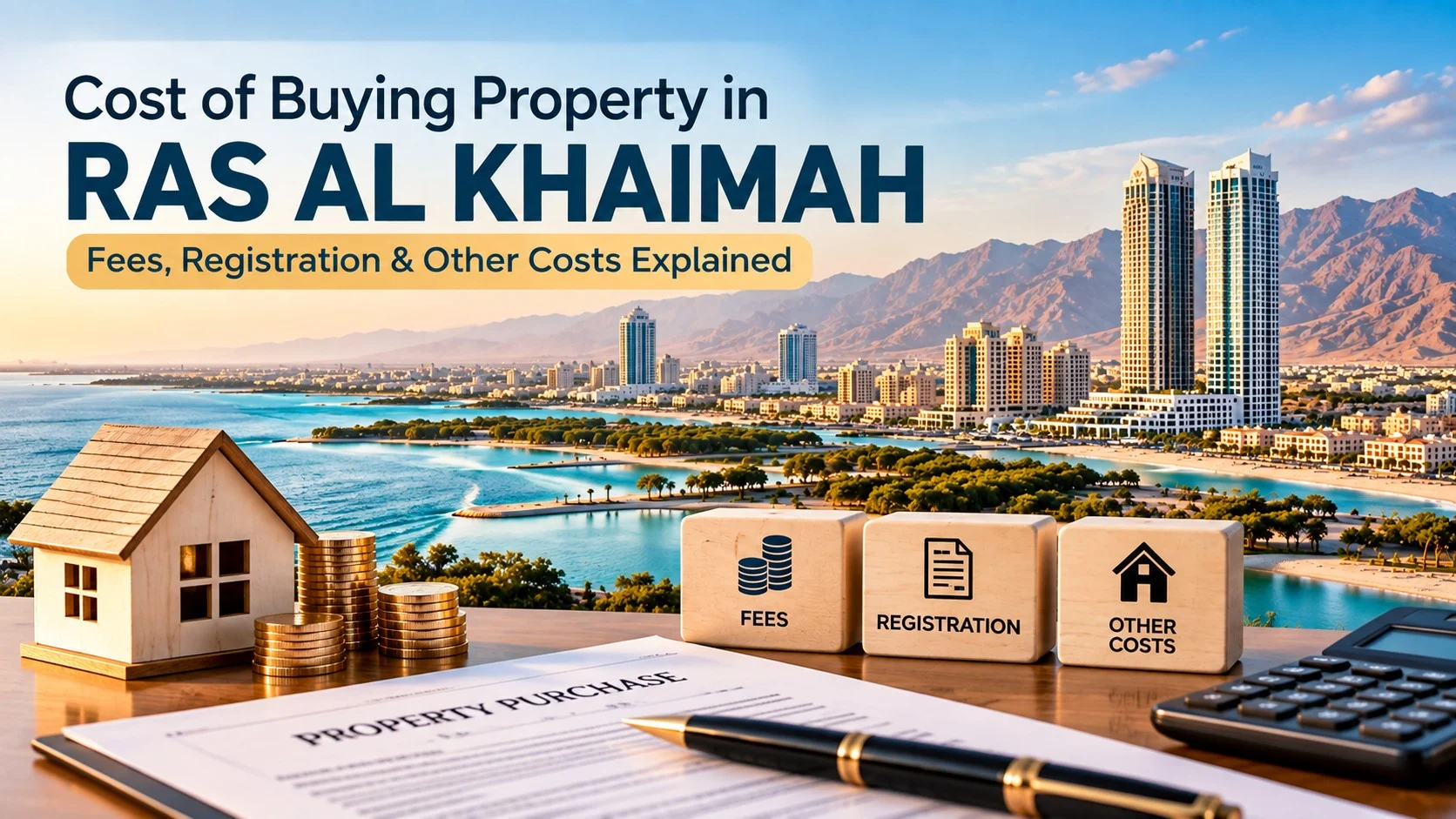


Ras Al Khaimah has quietly become one of the most talked-about markets in real estate UAE circles. Once seen as a quiet, value-driven alternative to its glamorous neighbour, the northern emirate is now posting the kind of growth that turns heads. The Wynn Al Marjan Island resort, a massive $5.1 billion project, has finally topped out and is gearing up for its 2027 opening. Meanwhile, prices across Ras Al Khaimah’s coastal communities keep going up, and tourism numbers haven’t shown any signs of slowing down. So, if you live here or you’re thinking about investing, you’re probably asking yourself: should I keep renting, or is it time to buy property?
The 2026 Ras Al Khaimah Market at a Glance
Let’s get straight to the numbers for 2026. The market’s pretty active right now. Prices are climbing fast. Al Marjan Island saw about a 21% jump in price per square foot since last year, and villas in Al Hamra Village jumped even higher, up to 42% per square foot. That’s not exactly pocket change, and it really changes how you look at renting versus buying. Prime apartments now command around AED 2,428 per square foot, the highest level in the current cycle, according to market data from ValuStrat and Bayut. Several forecasts expect a further 15–20% price increase across prime coastal zones in 2026.
The driver behind this momentum is structural, not speculative. Tourist arrivals reached a record 1.36 million in 2025 and are projected to approach five million annually as the emirate’s hospitality pipeline expands by over 9,500 hotel keys between 2026 and 2030. The Wynn resort acts as a powerful catalyst, creating what analysts describe as a “pre-opening squeeze” that is lifting prices while reducing available inventory in the best locations.
For anyone deciding whether to rent or buy, the takeaway is that you are entering a rising and tightening market.
The Case for Renting in Ras Al Khaimah
Renting still makes strong sense for many people, and it would be misleading to suggest otherwise.
Renting offers flexibility. If your job, family plans, or visa status could change within two to three years, locking up a large down payment in a single asset rarely pays off. Renters also avoid the upfront transaction costs of ownership, sidestep service charges and maintenance bills, and keep their capital liquid and available for other opportunities including a future purchase once they are more settled.
There is a catch, though. Rents in Ras Al Khaimah are rising too. Average rents have climbed by as much as 14% in key waterfront communities such as Mina Al Arab, driven by tenant demand for lifestyle-led living and the explosion of short-term holiday rentals. With visitor numbers heading toward record highs, a significant share of coastal units is being absorbed by short-stay demand, which tightens long-term rental supply and pushes asking rents higher. In other words, renting is the safe, flexible choice, but it is becoming a more expensive one each year.
The Case to Buy Property in Ras Al Khaimah
The argument to buy property in Ras Al Khaimah in 2026 rests on three pillars: yield, appreciation, and affordability relative to alternatives.
On yield, the emirate is genuinely competitive. Rental yields average around 7–8% for villas, townhouses and waterfront homes, with established communities like Al Hamra Village and Al Marjan Island delivering steady returns in the 5.5–5.8% range. Yield-hunters have found exceptional value in Yasmin Village, where apartment returns have exceeded 12%, while non-freehold villa areas such as Shamal Julphar return around 6.35%. Few mature markets globally offer income at these levels.
On appreciation, owners who bought before the current run-up have already seen meaningful capital gains, and limited beachfront supply combined with the Wynn effect suggests the trend has room to continue. When rents are rising and your mortgage payment is largely fixed, every year of ownership widens the gap in your favour.
On affordability, entry points remain accessible. Studio apartments can start near AED 500,000, and one bedroom coastal units sit well below comparable Dubai pricing – one reason foreign buyers increasingly view RAK as an affordable gateway into property in Dubai’s wider orbit without Dubai-level prices.
Renting vs. Buying: The 2026 Numbers
Here is a simplified, illustrative comparison for a one-bedroom coastal apartment to show how the maths works in practice. Your actual figures will vary by community, lender, and negotiation.
| Factor | Renting | Buying (with mortgage) |
| Upfront cash | 1–2 cheques + deposit (~5–10% of annual rent) | ~25–30% (down payment + fees) |
| Down payment (expat resident) | None | 20% up to AED 5M; 30% above |
| Down payment (non-resident) | None | 35–40% |
| Transaction fees | Agency fee (~5%) | ~5–7% (registration, agency, mortgage reg.) |
| Monthly cost | Rising rent (up ~10–14% in prime zones) | Mortgage at ~2.99–4.99% interest |
| Builds equity? | No | Yes |
| Captures price growth? | No | Yes |
| Flexibility | High | Lower (selling has costs) |
The key inputs come from current market conditions: UAE mortgage rates typically fall between 2.99% and 4.99%, expat residents need a deposit of at least 20% on properties up to AED 5 million (30% above that), and non-residents are generally asked for 35–40%. Total transaction costs in RAK usually land around 5–7% of the purchase price meaningfully lower than the 7–8% common in Dubai real estate, since registration and transfer fees are lighter.
The break-even logic is straightforward: if you plan to stay three to five years or more, rising rents plus equity build-up and capital appreciation usually tip the scales toward buying. If your horizon is shorter, renting protects your flexibility and your cash.
Who Should Rent and Who Should Buy?
Lean toward renting if you: expect to relocate within two to three years, want maximum flexibility, are still building your deposit, or are uncertain about long-term residency.
Lean toward buying if you: plan to stay three-plus years, want to convert rising rent payments into equity, are seeking rental income of 6–8%, qualify for a UAE Golden Visa through property ownership, or want exposure to RAK’s growth before the Wynn resort opens.
For investors specifically, the calculus is even clearer in a rising-rent, tightening-supply environment: owning lets you capture both yield and appreciation that renters simply forfeit.
How to Choose the Right Developer and Community
If you decide to buy, your developer matters as much as your location. Stick to established freehold zones Al Marjan Island, Al Hamra Village, Mina Al Arab and Yasmin Village where demand, infrastructure and liquidity are strongest. Off-plan projects make up most of the 2026 property pipeline. They usually offer flexible payment plans, but there’s always a risk the developer won’t finish on time or at all. So, it pays to check how reliable the developer has been in the past.
When you’re comparing options, look for straightforward payment schedules, a clear timeline for handover, registration with the RAK Land Department, and a solid track record for service charges.Whether you ultimately buy in RAK or compare it against property in Dubai, the discipline is the same: prioritise proven developers, prime locations, and realistic yield assumptions over hype.
Frequently Asked Questions
- Is it cheaper to rent or buy in Ras Al Khaimah in 2026? Over a short horizon (under three years), renting is usually cheaper because you avoid 5–7% in transaction costs and a large down payment. Over three to five years or more, buying typically wins as rising rents, equity build-up and capital appreciation outweigh the upfront costs.
- Can foreigners buy property in Ras Al Khaimah? Absolutely, foreigners can buy freehold property in places like Al Marjan Island, Al Hamra Village, and Mina Al Arab. In other locations, you’re more likely to find leasehold options instead.
- What about rental yields? Villas and waterfront homes usually bring in around 7–8%. In older, more established communities, yields land closer to 5.5–5.8%. But some places, like Yasmin Village, stand out apartments there can hit yields above 12%.
- How much deposit do I need to buy property in Ras Al Khaimah? Expat residents generally need at least 20% on properties up to AED 5 million (30% above that). Non-residents are usually asked for 35–40%. Budget another 5–7% for fees.
- Is Ras Al Khaimah a better investment than Dubai? Neither is universally “better.” A Dubai investment offers deeper liquidity and a longer track record from the best developers in Dubai, while RAK offers lower entry prices and earlier-cycle growth. Many investors hold both.
- Is prices in RAK keep rising in 2026?
Most forecasts predict about 15–20% growth, especially in those prime coastal areas. Beachfront homes are limited, tourism is booming, and the new Wynn resort opening in 2027 is just fanning the flames. Demand isn’t slowing down anytime soon.
The Bottom Line
In 2026, the renting-versus-buying decision in Ras Al Khaimah comes down to your time horizon and goals. Renting remains the right call for the flexible and the short-term, but in a market where rents are climbing and supply in prime areas is tightening, those payments increasingly enrich a landlord rather than you. For anyone planning to stay or invest for the medium to long term, the case to buy property in Ras Al Khaimah is compelling: accessible entry prices, yields among the best in the real estate UAE landscape, and a clear growth catalyst still ahead. Run your own numbers, choose a proven developer, and act with a clear horizon in mind.